


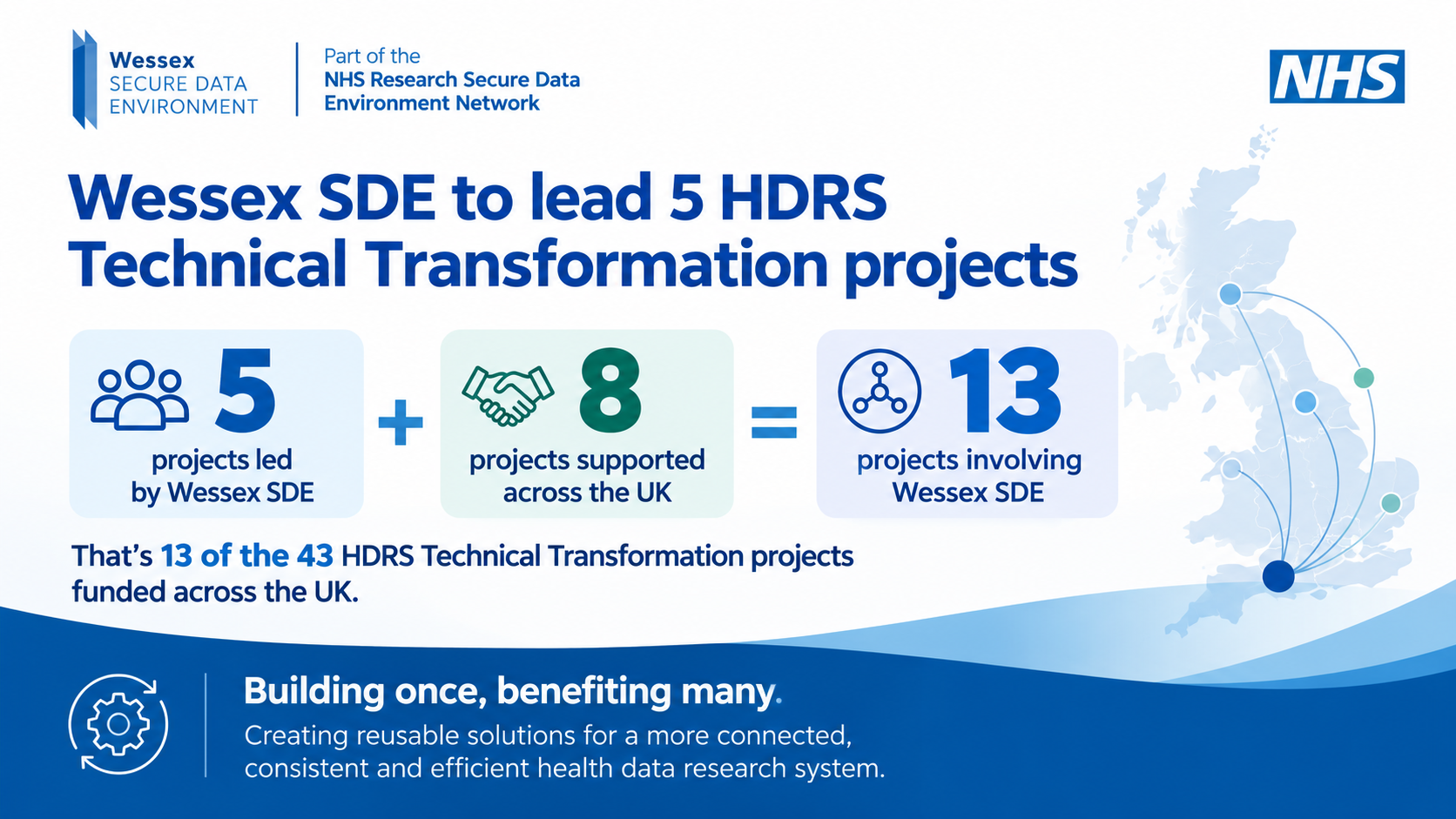
Wessex SDE will lead five projects funded by the Health Data Research Service (HDRS), while contributing to a further eight projects led by partners across the UK.
HDRS announced support for 43 Technical Transformation projects across the UK, selected with a particular focus on strategic fit and creating solutions that can be reused across the health data research system.
Five of these projects will be led by Wessex SDE, with Wessex supporting a further eight. The awards recognise Wessex’s role in developing approaches that can be shared and reused across the wider NHS Research SDE Network.
Together, we will improve the range and quality of health data available for research, help make data more consistent across the UK, strengthen information governance, support clinical trials and explore the safe use of AI and advanced computing. These are the five main areas being supported through HDRS Technical Transformation funding.
Building once, benefiting many
The five main areas being supported through HDRS Technical Transformation funding are:
- Improve the range and quality of health data available for research
- Help make data more consistent across the UK
- Strengthen information governance
- Support clinical trials
- Explore the safe use of AI and advanced computing.
A central principle of the HDRS programme is to avoid different parts of the NHS repeatedly solving the same technical and governance problems. HDRS has asked funded teams to share what they learn, produce tools and approaches that others can reuse, and plan for wider adoption.
Supporting teams to solve problems that are common to multiple SDEs ensures the best use of public funding and will support a more joined-up research system where investment in one place can benefit research across the UK.
For the public, the aim is to provide better value from HDRS’ investment in health data research. Reusing technology, standards, governance approaches and lessons learned reduces duplication and allows more funding and staff time to be focused on improving and expanding services rather than rebuilding the same infrastructure. It will also make it easier for approved researchers to use richer and more consistent data across the UK, while maintaining the safeguards that protect people’s information.
Ultimately, the Technical Transformation funding is creating stronger foundations for research to improve understanding of disease, develop and test treatments, improve services and help patients benefit from research more quickly.
The five Wessex-led projects
PRANA – improving data about road collisions and trauma
Building on the existing PRANA programme, this project will create reusable pipelines and data dictionaries to bring ambulance, air ambulance and trauma data securely into SDEs. This will make it easier to link information about what happens at the scene of a collision with subsequent NHS care and outcomes, supporting research to improve road safety and trauma care.
Connect-D – preparing better data for dementia research
This project will develop reusable tools for checking, preparing and standardising dementia data across UK SDEs. Using Connect-D as its first example, it will create open-source tools for checking data quality and putting data into a common format that can ultimately be adapted for other diseases and datasets.
The project brings together Wessex with Kent, Medway and Sussex, South West and West Midlands SDEs, alongside national dementia and health-data partners.
Bringing GP data into Wessex SDE
Wessex will adopt technology already used by OneLondon to establish a routinely refreshed primary care data service. This will initially support research using data from participating GP practices across Hampshire and the Isle of Wight, with Dorset data also incorporated where authorised.
The new capability will be particularly important for Connect-D, allowing researchers to study dementia across different parts of a person’s care, as well as supporting wider research into cancer, population health and other conditions.
Project Iceberg – unlocking information held in clinical text
Much valuable information in NHS records is contained in clinical letters, pathology reports and other free text, making it difficult to use reliably for research. Project Iceberg will develop a reusable service that can turn this unstructured information into structured, research-ready data while keeping a clear record of where the information came from and allowing appropriate clinical review.
The first demonstration will focus on extracting HER2 status and related information from breast cancer pathology reports. Importantly, the project is intended to create an approach that can later be adapted to other clinical documents and research questions.
Creating a national exemplar for research governance
Wessex will also lead work to develop and test a reusable approach for extending the regulatory permissions that SDEs need as their capabilities develop. The initial focus will be on securely hosting national study cohorts and supporting controlled re-identification and recruitment for clinical trials.
Rather than developing a solution only for Wessex, the project will produce adaptable templates, decision pathways, data-flow examples and implementation guidance that other UK SDEs can use. Public contributors and partner SDEs will help shape the approach alongside engagement with the Health Research Authority and Confidentiality Advisory Group.
Working across the UK
The funding also demonstrates the increasingly collaborative nature of the UK SDE network. Alongside the five projects it leads, Wessex SDE will contribute to eight further HDRS-enabled projects:
- National rare cancer tissue discovery, led by Eastern England SDE – developing a national catalogue to help researchers discover rare tumour tissue.
- HARMONY, led by Research Data Scotland – developing a federated dermatology imaging platform to support validation of skin cancer AI.
- NHS DigiTrials Recruitment Connect, led by NHS England SDE (National) – developing a route for regional SDEs to identify groups of people who may be suitable for a research study with NHS DigiTrials.
- Integrating OpenSAFELY tools into the South West SDE – exploring how OpenSAFELY approaches can be used within a regional SDE.
- DIA-core diabetes core dataset, led by South West SDE – implementing a common UK diabetes dataset for wider reuse.
- Enabling Secure Access to Sovereign AI Infrastructure, led by South West SDE – developing the governance needed to enable secure use of national AI computing infrastructure.
- Southern Partnership Single Point of Access, led by Kent, Medway and Sussex SDE – developing a more joined-up route through the three Southern Partnership Data Access Committees while retaining local decision-making.
- CoFIND, led by SAIL Databank – developing a way to search for groups of people who may be suitable for a research study across several SDEs without bringing their patient-level data together.
These projects form part of the same portfolio of 43 projects announced by HDRS.
Together, the 13 projects involving Wessex will help HDRS to create a more connected, consistent and reusable UK health data research infrastructure. We will make it easier to carry out high-quality research safely and deliver benefits for patients and the public, while maintaining the safeguards that protect people’s information.